
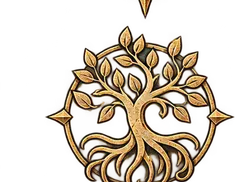

Aelthirien is traditionally translated as The Place Where the World Still Remembers.
Not a Kingdom
The Elderwood, called Aelthirien in elven tradition, has no conventional capital, monarch, national census, or fixed political border that can be drawn accurately on a map.
Communities are decentralized. Authority may belong to councils, elders, specialists, spiritual leaders, family representatives, or temporary assemblies depending on place and need.
Aelthirien is the most famous elven homeland, but elves also live in Valemere, Caelora, ports, the Shattered Isles, and mixed communities throughout Veyra. Ancestry does not automatically mean Elderwood upbringing.
An Unmappable Interior
No reliable conventional map of the interior exists. Paths change, streams shift, clearings appear or vanish, and distances may not behave consistently. A route short in one season may take much longer in another.
Elves navigate by relationships, signs, memory, environment, and living knowledge rather than a fixed road atlas.
Two methods of safe deep travel are widely accepted: travel with an elf who genuinely knows the forest, or carry a genuine blessing recognized by the Old Gods. This is not simply a difficult navigation problem. The Elderwood behaves differently from ordinary geography.
Ilyratha, the Great Tree
At the spiritual heart of the Elderwood stands Ilyratha, the Great Tree. Ilyratha is not regarded as a monarch or a god.
The Elderwood's public traditions place Ilyratha at the center of a landscape shaped by memory, ecology, old sacred practice, and relationships that outsiders cannot reduce to ordinary political geography.
Aelthiric and Long Memory
Modern Aelthiric remains in use throughout Elderwood traditions. High or Ancient Aelthiric survives in old texts, ritual, song, inscriptions, and ruins; speaking the modern language does not automatically grant literacy in its ancient forms.
Elves commonly live 500–800 years. That longevity can make historical events part of living memory, but it does not guarantee perfect recollection, wisdom, or agreement. Elderwood communities preserve history through people, texts, ritual, craft, and living traditions.
Craft, Magic, and Living Technology
An Elderwood settlement may appear technologically simple while relying on magical and ecological techniques outsiders cannot reproduce.
Aelthirien uses traditional handcraft, sophisticated herbal medicine, magical cultivation, living architecture, subtle wards, ritual construction, and materials harvested with attention to long-term ecological effects.
A bridge may be grown around existing trees. A house may incorporate living roots and shaped wood rather than cut beams. Elderwood magical traditions are often associated with nature, healing, light, dreams, ritual, transformation, and subtle enchantment.
Traditional communities still place special value on handwritten and living-record forms for sacred or personal knowledge, though elves are not unfamiliar with print.
Education and Housing
Education is often mentorship-based and community-specific. Children may learn ecology, history, art, local navigation, ritual, languages, craft, and survival over long periods.
Construction may incorporate living trees, shaped growth, traditional timbercraft, stone, and local magical methods. Elves do harvest wood and hunt; the cultural distinction is one of relationship, stewardship, and waste rather than absolute prohibition.
Old Gods and the Living Vine
Elderwood life is strongly associated with traditions of the Old Gods, though public Veyran theology remains contested and incomplete.
Elven Marks appear as vine-like patterns. A Fixed Mark forms a completed vine, leaf, bud, curl, or closed knot; an Open Mark branches into unfinished tendrils. Elderwood traditions often describe the difference as the blood took form for Fixed and the blood opened for Open.
Time and Relations with Outsiders
Elven communities frequently describe time through seasonal, astronomical, biological, and event-based references alongside SR. A phrase such as “the winter after the silver birches flowered twice” can be perfectly useful local history.
Formal dealings with outsiders use conventional dates when necessary. Valemere maintains the strongest regular relationship with the Elderwood, but even friendly outsiders do not receive unrestricted access.